Data Monetization: Selling Insights from Custom GPT Interactions
Turn GPT user interactions into valuable market intelligence. Learn how to ethically monetize aggregated insights without compromising user privacy or trust.


Last updated: January 4, 2026
Every conversation your Custom GPT has generates valuable data. Users reveal their problems, priorities, decision-making processes, and pain points. Aggregated and anonymized, this data becomes market intelligence worth USD 5,000-50,000+ to the right buyers.
The challenge: monetizing this data while respecting user privacy and maintaining trust. Get it wrong, and you face legal issues and reputation damage. Get it right, and you unlock a revenue stream that compounds with every new user.
For traditional GPT monetization, see our Custom GPT monetization models guide. For access control, explore GPT Access Control strategies.
What Data Your GPT Actually Captures

Before monetizing data, understand what your GPT sees and stores:
Data Types Available
-
Conversation patterns:
- Topics users ask about most
- Questions they ask repeatedly
- How they phrase requests
- Common follow-up questions
-
User behavior patterns:
- Time of day usage peaks
- Session length averages
- Feature usage frequency
- Workflow sequences
-
Problem identification:
- What challenges users are trying to solve
- Which solutions they reject and why
- Budget constraints mentioned
- Timeline expectations
-
Decision-making insights:
- What criteria matter most
- How users compare options
- Common objections and concerns
- Deal-breakers in their context
Data NOT Available (OpenAI Limitations)
Your Custom GPT does not have access to:
- User's personal information (unless they provide it in conversation)
- User's other ChatGPT conversations
- User's email or account details
- Conversation history across sessions (without explicit memory features)
You can only analyze what happens within your GPT's conversations.
Legal and Ethical Boundaries

Data monetization requires strict adherence to privacy laws and ethical standards.
What's Legal (and Ethical)
✅ Aggregated, anonymized insights
- "75% of users in this industry ask about X problem"
- "Common budget ranges mentioned: USD 10k-50k"
- "Peak usage times: Tuesday-Thursday 9-11 AM"
- "Top 5 features users care about, ranked"
✅ Trend reporting
- "Emerging interest in [topic] increased 40% month-over-month"
- "Users shift from prioritizing [X] to [Y]"
- "New pain points appearing in [industry]"
✅ Benchmark data
- "Average deal size in this vertical: USD 75k"
- "Typical sales cycle length: 45-60 days"
- "Conversion rate industry average: 18%"
What's Illegal (or Unethical)
❌ Individually identifiable data
- Selling specific user conversations
- Sharing company names with their specific questions
- Revealing individual users' decision criteria
❌ Data sold without consent
- No disclosure in terms of service
- No opt-out mechanism
- Retroactively changing terms to allow data sales
❌ Competitive intelligence abuse
- Selling Company A's data to their competitor Company B
- Revealing strategic plans mentioned in conversations
- Sharing proprietary information users assumed was private
Required Disclosures
Your GPT's terms of service must clearly state:
DATA USAGE DISCLOSURE

We collect and analyze aggregated, anonymized data from GPT conversations
to understand industry trends and user needs. This anonymized data may be
sold to third parties as market research.

We will NEVER:
- Share your individual conversations
- Reveal your company name or identifying information
- Sell data that can be traced back to specific users

You may opt out of data collection by emailing [contact]
Include this in:
- Your GPT's description
- Your website's privacy policy
- Email confirmation when users first access your GPT
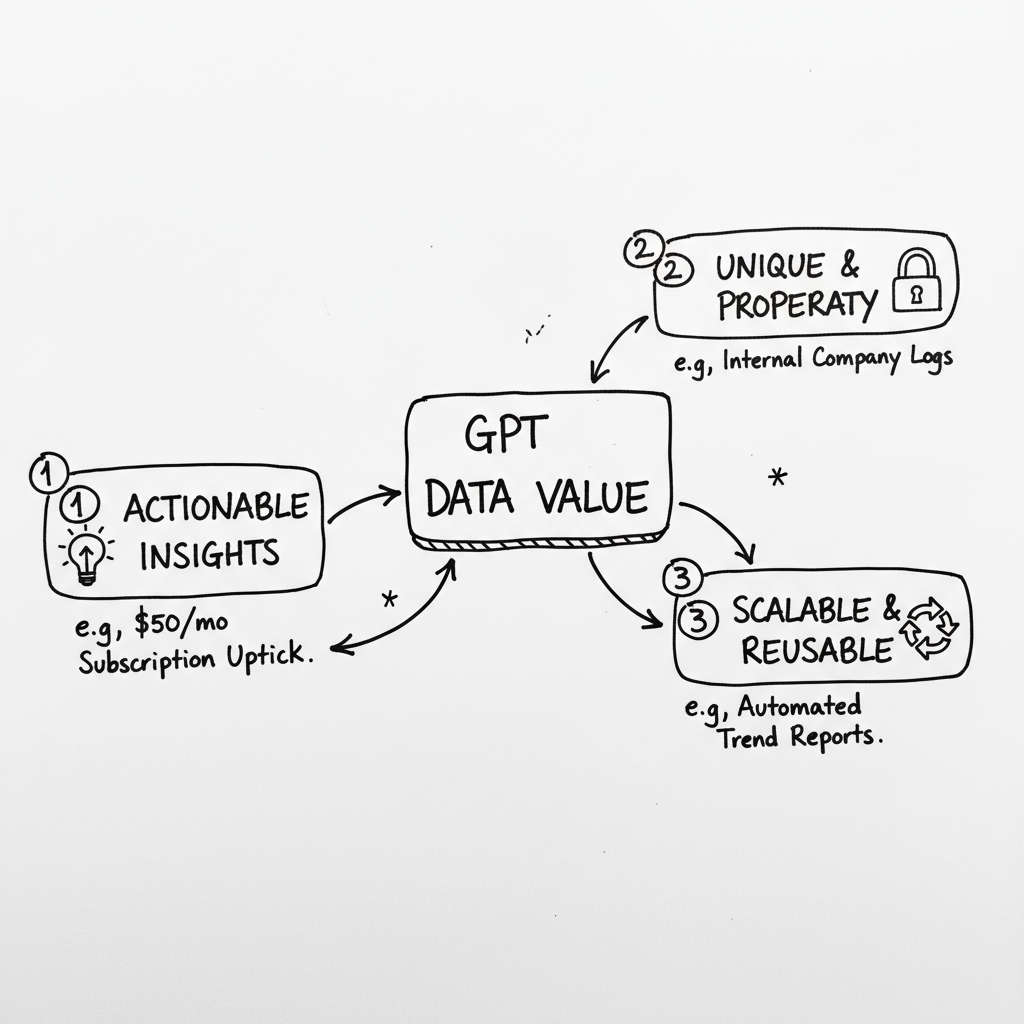
What Makes GPT Data Valuable
To Marketing Your Custom GPT: From Zero to Paying Customers, see our Marketing Your Custom GPT: From Zero to Paying Customers.
Not all data is equally monetizable. Focus on insights that:
1. Reveal Hidden Market Needs
What buyers want: Problems their customers have that surveys don't capture
Example valuable insight: "38% of SaaS founders using pricing GPTs mention difficulty explaining value-based pricing to boards. Current solutions focus on customer communication, missing the board presentation angle."
Why this is worth USD 5k-10k: Product teams at pricing software companies would pay to know this gap exists.
2. Show Behavioral Patterns
What buyers want: How people actually behave vs. what they say they'll do
Example valuable insight: "Users claim budget is their top priority, but conversation analysis shows 62% choose recommendations based on implementation speed over cost when both are mentioned."
Why this is worth USD 10k-20k: Marketing teams can adjust messaging from "cheapest" to "fastest deployment" and increase conversions.
3. Identify Emerging Trends Early
What buyers want: Signals that markets are shifting before competitors notice
Example valuable insight: "Mentions of 'AI compliance' in legal GPT conversations increased 340% in Q1 2026, primarily from fintech companies. No current solutions exist specifically for AI compliance in financial services."
Why this is worth USD 20k-50k: Early mover advantage for companies building solutions.
Who Buys GPT Interaction Data
Different buyers value different insights:
Buyer Type 1: Product Teams
What they buy: Feature requests, pain points, usage patterns
Use case: Validate product roadmap, identify gaps in market
Price range: USD 5,000-25,000 for comprehensive reports
Example: SaaS company building project management tools wants to know what features users say are "missing" from existing solutions
Buyer Type 2: Market Research Firms
What they buy: Industry trends, sentiment analysis, behavior patterns
Use case: Sell aggregated reports to multiple clients
Price range: USD 10,000-50,000 for exclusive insights
Example: Gartner-style firm wants quarterly trend reports on enterprise software adoption patterns
Buyer Type 3: Venture Capital Firms
What they buy: Market size indicators, willingness to pay, problem validation
Use case: Validate investment theses, identify opportunities
Price range: USD 15,000-75,000 for sector-specific intelligence
Example: VC firm evaluating edtech investments wants data on what educators say they need (not what edtech vendors think they need)
Buyer Type 4: Consultancies
What they buy: Client benchmarks, best practices, decision criteria
Use case: Improve recommendations to clients with data-backed insights
Price range: USD 5,000-20,000 for vertical-specific data
Example: Management consulting firm wants aggregated data on how CFOs evaluate pricing decisions
Implementation: Data Collection Architecture
OpenAI doesn't provide native analytics for Custom GPTs. You need to build your own:
Option 1: API Integration with Custom Database
How it works:
- Configure your GPT with Actions pointing to your server
- Log key conversation events to your database
- Use API calls to capture: timestamps, topics, user actions
- Aggregate data weekly/monthly for analysis
Technical requirements:
- Backend server (Node.js, Python, etc.)
- Database (PostgreSQL, MongoDB, etc.)
- API endpoint for GPT to call
- Analytics dashboard (Metabase, Tableau, custom)
Pros: Full control over data, detailed analytics Cons: Requires technical setup, ongoing maintenance
Option 2: Third-Party Analytics Integration
How it works:
- Use webhook services (Zapier, Make.com)
- GPT calls webhook on specific triggers
- Webhook logs data to Google Sheets or Airtable
- Analyze with spreadsheet tools or BI platforms
Technical requirements:
- Zapier/Make.com account
- Google Sheets or Airtable
- Basic no-code automation skills
Pros: No-code setup, easy to start Cons: Less flexibility, data limits at scale
Option 3: Manual Conversation Exports
How it works:
- Review conversations manually (if low volume)
- Extract patterns and insights
- Aggregate findings into reports
- Sell reports to interested buyers
Technical requirements: None
Pros: Zero technical setup, works immediately Cons: Doesn't scale, labor-intensive
Packaging Insights for Sale
Raw data isn't valuable - insights are. Here's how to package:
Format 1: Quarterly Trend Reports
Structure:
- Executive summary (1 page)
- Top 10 trends identified with data
- Methodology and sample size
- Implications and recommendations
- Appendix with supporting data
Price: USD 5,000-15,000 per report
Buyers: Market research firms, VC firms
Format 2: Custom Research Projects
Structure:
- Client defines specific questions they want answered
- You analyze your GPT data for answers
- Deliver custom report addressing their questions
- Include raw (anonymized) data where appropriate
Price: USD 10,000-50,000 depending on scope
Buyers: Product teams, consultancies
Format 3: Ongoing Data Subscriptions
Structure:
- Monthly or quarterly data updates
- Access to dashboard showing real-time trends
- Regular briefings on emerging patterns
- Priority access to new insights
Price: USD 2,000-10,000 per month
Buyers: Organizations needing continuous intelligence
Maintaining User Trust
Data monetization fails if users don't trust you. Trust requires:
Transparency Principle
Be explicit about what you collect and how you use it:
In your GPT's first response: "Quick note: I analyze conversation patterns across all users to understand industry trends. This helps improve my recommendations and generates anonymized market research. Your individual conversations remain private. Details: [link to privacy policy]"
User Control Principle
Give users choice:
Opt-out mechanism: "Don't want your conversation data included in trend analysis? Email opt-out@yourGPT.com with your session ID and we'll exclude your data."
Value Exchange Principle
Show users what they get in return:
Quarterly insights sharing: "Because you use this GPT, you get free access to our quarterly industry trend report (normally USD 5,000). Here's what we found this quarter..."
Users who benefit from the data are more willing to contribute to it.
Pricing Your Data Insights
Data value depends on:
Factor 1: Sample Size
| Users | Data Value Multiplier |
|---|---|
| 100-500 | 1x baseline |
| 500-2,000 | 2-3x baseline |
| 2,000-10,000 | 4-6x baseline |
| 10,000+ | 8-10x baseline |
Larger samples = more statistically significant = higher value.
Factor 2: Niche Specificity
| Niche Type | Value Multiplier |
|---|---|
| General consumer | 1x |
| Specific industry (e.g., "healthcare") | 3-5x |
| Specific role + industry (e.g., "hospital CFOs") | 8-12x |
Narrow, hard-to-reach audiences pay premium prices.
Factor 3: Exclusivity
| Distribution Type | Price Impact |
|---|---|
| Public report (anyone can buy) | 1x |
| Limited distribution (max 10 buyers) | 3-4x |
| Exclusive (single buyer, 6-12 months) | 8-15x |
Exclusivity commands massive premiums.
Revenue Modeling
Example revenue scenarios:
Scenario 1: Small GPT (500 users/month)
- Quarterly trend report (USD 5,000) × 4 = USD 20,000/year
- Total annual revenue: USD 20,000
Scenario 2: Medium GPT (5,000 users/month)
- Quarterly reports (USD 15,000) × 4 = USD 60,000/year
- Custom projects (USD 25,000) × 2 = USD 50,000/year
- Total annual revenue: USD 110,000
Scenario 3: Large GPT (25,000 users/month)
- Monthly subscription (USD 8,000 × 12) = USD 96,000/year
- Exclusive annual data license (USD 200,000)
- Custom projects (USD 30,000) × 3 = USD 90,000/year
- Total annual revenue: USD 386,000
Frequently Asked Questions
Is selling anonymized GPT data legal?
Yes, if properly disclosed and truly anonymized. GDPR/CCPA allow anonymized data sales. Key: data must not be re-identifiable. Consult a privacy lawyer for your specific jurisdiction.
What if a user's company is identifiable from context?
Remove or generalize identifying details. Example: Change "We're a 50-person SaaS company in fintech based in NYC" to "Mid-size financial services software company."
Can I sell data from free GPTs?
Yes, but disclosure is critical. Users of free services often assume "you're the product." Make it explicit that data monetization funds the free access.
What if my GPT has access control (paid access)?
Paid users may expect higher privacy. Consider excluding their data, charging more to compensate, or offering premium "no data collection" tier.
How do I find data buyers?
- Reach out to market research firms directly
- Post on Gumroad, Patreon with "market intelligence" positioning
- LinkedIn outreach to product managers, VCs, strategy consultants
- Partnerships with existing research platforms
What analytics should I track?
Focus on actionable insights: common questions, pain points mentioned, features requested, budget ranges discussed, decision criteria, objections to solutions, workflow patterns.
Start Monetizing Your GPT Data
Data monetization works when you provide valuable insights ethically. Build trust, respect privacy, and the revenue follows.
Your next steps:
- This week: Add data collection disclosure to your GPT and terms
- This month: Implement basic analytics tracking
- Next 90 days: Create first trend report and find your first buyer
For GPTs using access codes for monetization, TheGPTShop provides secure infrastructure starting at USD 5 per code.
Related Articles
To learn more about custom gpt monetization, see our Custom GPT Monetization: 6 Revenue Models That Actually Work.
- Custom GPT Monetization: 6 Revenue Models That Actually Work
- How to Monetize Custom GPTs: The Complete Revenue Guide
- Affiliate Marketing with Custom GPTs
- GPT Access Control: Selling Without Getting Copied
Sources & Citations:
- GDPR and CCPA data privacy regulations
- Market research industry pricing benchmarks
- Analytics and data monetization best practices


