Affiliate Marketing with Custom GPTs: Turn Recommendations Into Revenue
Monetize Custom GPTs through affiliate commissions. Learn how to build recommendation engines that earn 5-30% commissions while providing genuine value to users.


Last updated: January 4, 2026
Most Custom GPT creators think monetization means charging for access. They're missing a massive revenue opportunity: affiliate commissions. A well-designed recommendation GPT can generate USD 500-5,000+ monthly in affiliate revenue while simultaneously providing free value to users.
The affiliate model works because it aligns incentives perfectly. Users get free, expert recommendations. Merchants get qualified customers. You earn commission for facilitating valuable matches. Everyone wins.
For other monetization approaches, see our Custom GPT monetization models guide. For access-controlled monetization, explore GPT Access Control strategies.
Why Affiliate Marketing Works for Custom GPTs

To Marketing Your Custom GPT: From Zero to Paying Customers, see our Marketing Your Custom GPT: From Zero to Paying Customers.
Affiliate marketing isn't new. What's new is using AI to make genuinely helpful recommendations at scale.
The traditional affiliate problem:
- Generic product recommendations (not personalized)
- Low trust (users assume you're just selling)
- High friction (users still need to research)
- Poor conversion rates (2-5% typical)
The Custom GPT affiliate solution:
- Personalized recommendations based on specific needs
- High trust (GPT asks questions, understands context)
- Low friction (GPT explains why this product fits)
- Higher conversion rates (8-15% with good GPTs)
Revenue example:
| Model | Revenue per 1,000 users |
|---|---|
| Traditional affiliate blog | USD 50-200 (2-5% conversion × USD 50 commission) |
| Generic AI chatbot | USD 100-300 (5% conversion × USD 60 commission) |
| Well-designed Custom GPT | USD 400-900 (10-15% conversion × USD 60 commission) |
The difference: specificity and trust.
High-Commission Affiliate Programs for GPTs

Not all affiliate programs are worth building GPTs around. Focus on programs with:
- High commission rates (20%+ preferred)
- Long cookie duration (30+ days)
- Recurring commissions (subscription products)
- Good product quality (your reputation matters)
Top affiliate programs by category:
Software & SaaS (20-50% commissions, often recurring)
- Productivity tools: Notion, Airtable, ClickUp (20-30%)
- Marketing software: HubSpot, ConvertKit, Mailchimp (20-50%)
- Development tools: GitHub, Vercel, AWS (various)
- Design tools: Canva, Figma (20-30%)
Why SaaS works: Recurring commissions mean one customer = months/years of revenue
Physical Products (5-15% commissions)
- Amazon Associates: 1-10% depending on category
- Home & Garden: Wayfair, Home Depot (3-8%)
- Electronics: Best Buy, B&H Photo (1-4%)
- Fitness: Rogue Fitness, REI (5-10%)
Why physical products work: High order values offset lower commission rates
Online Courses & Education (30-50% commissions)
- Course platforms: Teachable, Udemy, Coursera (20-50%)
- Individual creators: Many offer 30-50% through custom programs
- Professional development: LinkedIn Learning, Skillshare (varies)
Why education works: High-value purchases (USD 200-2,000+) with great margins
Hosting & Infrastructure (50-100% commissions)
- Web hosting: Bluehost, SiteGround, WP Engine (USD 65-200 per signup)
- Cloud services: DigitalOcean, Linode (USD 25-100 per signup)
- Domain registrars: Namecheap, Domain.com (varies)
Why hosting works: One-time high payouts, plus potential recurring
GPT Architectures That Convert
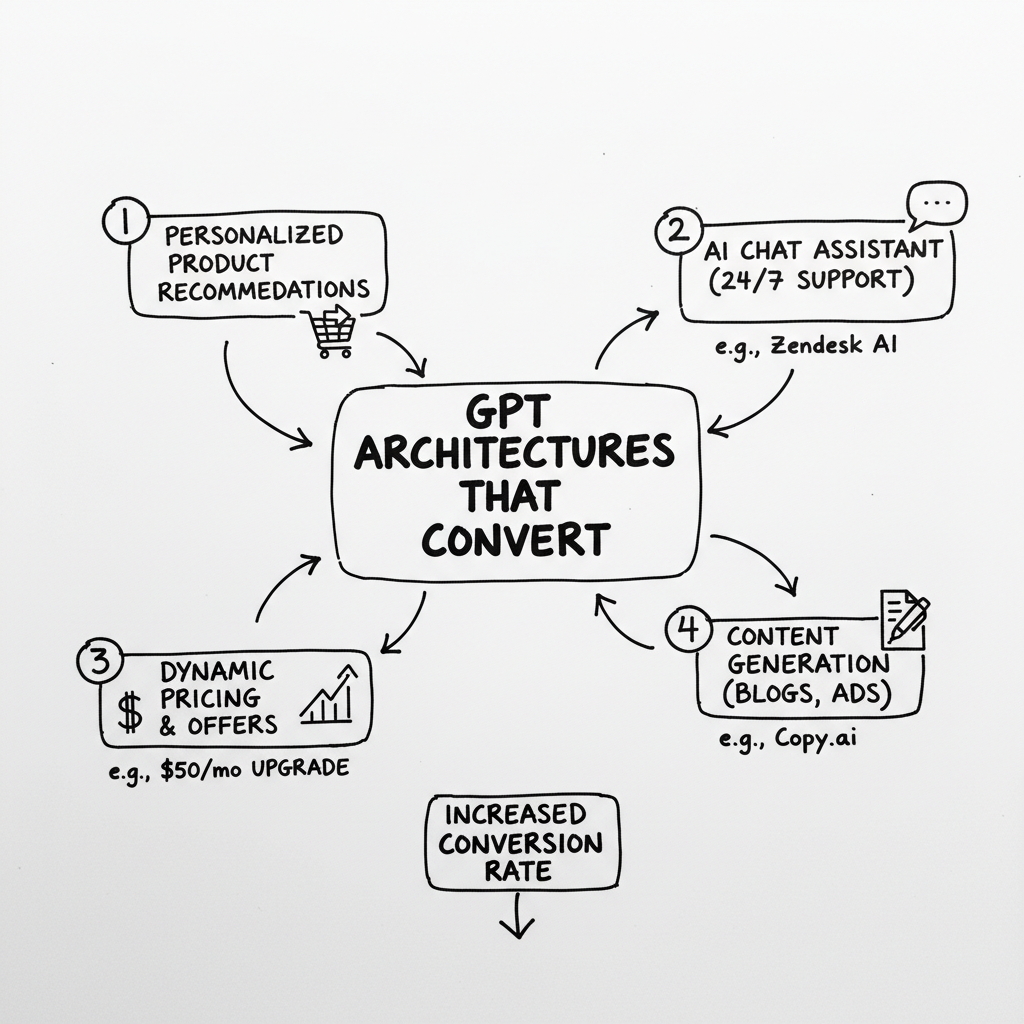
The GPT's design determines conversion rate. Here are proven architectures:
Architecture 1: The Needs Assessment GPT
How it works: Ask questions to understand user needs, recommend products that match
Example: Productivity Software Finder
Instructions:
You help users find the perfect productivity tools.

Step 1: Ask what they're trying to accomplish
Step 2: Ask about their team size and budget
Step 3: Ask about existing tools and pain points
Step 4: Analyze and recommend 2-3 specific tools
Step 5: Explain why each tool fits their situation
Step 6: Provide affiliate links with "Learn More" CTA

Never recommend without understanding needs first.
Why it works: Users feel heard. Recommendations are specific, not generic.
Architecture 2: The Comparison GPT
How it works: Help users compare options, highlight differences, make decision easier
Example: SaaS Comparison Tool
Instructions:
You help users compare software options.

When users mention products or categories:
1. Ask what specific features matter most to them
2. Compare products across those dimensions
3. Highlight key differences and tradeoffs
4. Recommend based on their priorities
5. Provide affiliate links for trial signups

Include pricing, features, pros/cons in comparisons.
Why it works: Users already know options. You provide clarity and confidence.
Architecture 3: The Problem-Solver GPT
How it works: Start with user's problem, recommend solutions (some happen to be affiliate products)
Example: Marketing Problem Solver
Instructions:
You help marketers solve specific problems.

When users describe a challenge:
1. Clarify the exact problem and constraints
2. Suggest 3-4 different solution approaches
3. For approaches involving tools, recommend specific products
4. Explain implementation steps
5. Include affiliate links where relevant

Focus on solving problems, not selling products.
Why it works: Recommendations feel like natural solutions, not sales pitches.
Implementation: Adding Affiliate Links to GPTs
GPTs can't directly use affiliate links in responses, but there are effective workarounds:
Method 1: Knowledge File with Affiliate Links
Upload a knowledge file containing product information and affiliate links:
# Product Database

## Notion
- Description: All-in-one workspace for notes, docs, and collaboration
- Best for: Teams 1-50 people, knowledge management
- Pricing: Free to USD 10/user/month
- Affiliate link: https://notion.so?via=youraffiliateID

## Airtable
- Description: Spreadsheet-database hybrid for flexible data management
- Best for: Custom workflows, CRM, project tracking
- Pricing: Free to USD 20/user/month
- Affiliate link: https://airtable.com?ref=youraffiliateID
To Building Custom GPTs: The Complete Technical Guide, see our Building Custom GPTs: The Complete Technical Guide.
When your GPT recommends a product, it pulls from this file and includes the affiliate link.
Method 2: Link Shortener with Redirects
Use a URL shortener (Bitly, Short.io) to create branded links:
https://yourdomain.com/notion → https://notion.so?via=yourID
https://yourdomain.com/airtable → https://airtable.com?ref=yourID
Benefits:
- Cleaner links in GPT responses
- Can update destination without changing GPT
- Track click analytics
- Build brand trust (your domain vs. messy affiliate URLs)
Method 3: Landing Page Redirects
Create simple landing pages for each recommendation:
https://yoursite.com/notion-review
→ Brief review/overview
→ "Get started with Notion" button (affiliate link)
→ Track conversions
Why this works better:
- Adds credibility (your review/analysis)
- Can capture emails before redirect
- Retarget with ads if needed
- Better conversion than direct affiliate links
Disclosure and Trust
Affiliate GPTs only work long-term if users trust you. Dishonesty kills trust instantly.
Required disclosures:
-
In GPT description: "This GPT earns affiliate commissions when you purchase recommended products."
-
In GPT instructions: Include disclosure in first response
Instructions:
On first interaction, include this disclosure:

"I earn affiliate commissions when you purchase products I recommend.
I only recommend products I genuinely believe solve your problem.
My goal is finding the right fit for you, not maximizing commissions."

Then proceed with helping the user.
- With each recommendation: Brief inline disclosure
Example response:
"Based on your needs, I recommend Notion [affiliate link]. It's perfect for
your use case because [reasons]. Full disclosure: I earn a commission if
you sign up, but I only recommend products that genuinely fit."
Why disclosure helps (not hurts):
- Users expect affiliate relationships (they're standard online)
- Transparency builds trust
- FTC requires disclosure anyway
- Honest creators outperform dishonest ones long-term
Optimizing for Conversions
Getting users to click and purchase requires optimization:
Optimization 1: Specificity in Recommendations
Bad: "You should use a project management tool like Asana or Monday." Good: "For your 8-person team managing client projects, Monday.com works better than Asana because it has built-in client portal features you mentioned needing."
Specific recommendations convert 3x better than generic ones.
Optimization 2: Explain the "Why"
Users don't buy features. They buy outcomes.
Feature-focused (weak): "Notion has databases, wikis, and kanban boards." Outcome-focused (strong): "Notion lets you centralize all your team docs, project trackers, and meeting notes in one place. That means your team spends less time searching and more time executing."
Optimization 3: Address Objections Proactively
Common objections:
- Too expensive
- Too complex
- Might not work for my use case
- Don't want to switch from current tool
Proactive handling: "Notion starts free for individuals, so you can test it risk-free. The learning curve is about 2-3 days for basic features. If you're currently using [their tool], Notion can import your data directly."
Optimization 4: Create Urgency (Honestly)
Dishonest urgency (avoid): "This deal expires in 24 hours!" (when it doesn't) Honest urgency: "Most tools offer 14-30 day free trials. Starting today means you'll know if it works before committing."
Revenue Modeling
Affiliate GPT revenue depends on traffic and conversion:
Revenue formula:
Monthly Revenue = Visitors × Conversion Rate × Average Commission
Example scenarios:
| Monthly Visitors | Conversion Rate | Avg Commission | Monthly Revenue |
|---|---|---|---|
| 500 | 8% | USD 50 | USD 2,000 |
| 1,000 | 10% | USD 60 | USD 6,000 |
| 2,000 | 12% | USD 70 | USD 16,800 |
How to increase each variable:
-
More visitors:
- Content marketing (SEO-focused blog posts)
- Social media sharing
- Community engagement
- Partnerships with newsletters/podcasts
-
Higher conversion:
- Better needs assessment
- More specific recommendations
- Stronger trust signals
- Reduced friction in purchase flow
-
Higher commissions:
- Focus on high-ticket items
- Promote products with recurring commissions
- Negotiate custom commission rates (after volume)
Scaling Affiliate GPT Revenue
Once you prove the model works, scale through:
Strategy 1: Multi-Niche Portfolio
Build GPTs in different niches using the same architecture:
- SaaS Comparison GPT → targets businesses
- Course Finder GPT → targets learners
- Hosting Comparison GPT → targets new site owners
- Fitness Equipment GPT → targets athletes
Each GPT operates independently but uses proven templates.
Strategy 2: Traffic Partnerships
Partner with people who have audiences:
- Newsletter owners (promote your GPT to their list)
- YouTube creators (mention your GPT in relevant videos)
- Podcast hosts (sponsor episodes, mention your GPT)
- Bloggers (guest posts linking to your GPT)
Pay them 10-20% of generated affiliate revenue as incentive.
Strategy 3: Paid Acquisition
Once you know lifetime value (LTV) of a visitor, you can profitably buy traffic:
Example math:
- Cost per click: USD 0.50 (Google/Facebook ads)
- Conversion rate: 10%
- Average commission: USD 60
- LTV per visitor: USD 6 (10% × USD 60)
- ROI: 12x (USD 6 revenue / USD 0.50 cost)
If your math works, scaling is just adding ad budget.
Frequently Asked Questions
Can I use affiliate links in GPT responses?
Not directly in the response text (links may not be clickable), but you can include them in knowledge files or direct users to landing pages with affiliate links.
How do I disclose affiliate relationships?
Include disclosure in your GPT's description, in the first response users see, and with each recommendation. FTC requires "clear and conspicuous" disclosure.
What if users don't click affiliate links?
Focus on value first. If your recommendations genuinely help, clicks follow naturally. Don't optimize for clicks - optimize for helpful recommendations that happen to include clicks.
Can I combine affiliate revenue with other monetization?
Yes. Many creators offer free GPT access (funded by affiliates) plus premium features behind access codes. Affiliate revenue covers costs, access codes generate profit.
How long do affiliate cookies last?
Varies by program. Amazon: 24 hours. Most SaaS: 30-90 days. Some: lifetime. Choose programs with longer cookie durations for better conversion.
Do I need approval from affiliate programs?
Yes, most programs require application and approval. Start with easy-to-join programs (Amazon, ShareASale) then apply to specific brands once you have traffic to show.
Start Earning Affiliate Revenue
Affiliate marketing works when recommendations genuinely help users. Build that foundation, and revenue follows.
Your next steps:
- This week: Choose one niche and build a recommendation GPT
- This month: Get 100 users and validate conversion rate
- Next 90 days: Scale to USD 1,000+ monthly affiliate revenue
For GPTs requiring access control instead of (or in addition to) affiliate revenue, TheGPTShop provides secure access codes starting at USD 5.
To learn more about custom gpt monetization, see our Custom GPT Monetization: 6 Revenue Models That Actually Work.
Related Articles
- Custom GPT Monetization: 6 Revenue Models That Actually Work
- How to Monetize Custom GPTs: The Complete Revenue Guide
- Do Custom GPT Creators Get Paid?
- GPT Access Control: Selling Without Getting Copied
Sources & Citations:
- Affiliate marketing industry benchmarks (2024-2026)
- FTC affiliate disclosure requirements
- SaaS affiliate program documentation


