Custom GPT Consulting: How to Sell Your Expertise for $2,000-$10,000 Per Project
Turn your Custom GPT skills into high-value consulting services. Learn how to position, price, and deliver GPT development projects that clients happily pay $2,000-$10,000+ for.


Last updated: January 4, 2026
Custom GPT consulting is the fastest way to generate USD 5,000-50,000+ monthly as a creator. While building and selling your own GPTs can take months to reach USD 1,000/month, consulting clients pay USD 2,000-10,000 per project immediately. No audience building required. No waiting for distribution. Just expertise, positioning, and the ability to deliver results.
This guide covers everything you need to launch and scale a Custom GPT consulting practice, from finding clients to delivering projects that command premium prices.
For other monetization models, see our Custom GPT monetization strategies. For building technical expertise, explore Building Custom GPTs guide.
Why GPT Consulting Works (And Who It's For)

To Marketing Your Custom GPT: From Zero to Paying Customers, see our Marketing Your Custom GPT: From Zero to Paying Customers.
Custom GPT consulting works because businesses understand value but lack expertise.
What businesses see:
- "Our customer support team spends 20 hours/week answering repetitive questions"
- "Our sales team wastes time writing similar proposals over and over"
- "Our onboarding process is inconsistent because everyone trains differently"
What they don't see:
- How to translate these problems into GPT solutions
- What instructions actually work
- How to implement knowledge bases
- How to ensure consistent outputs
That gap between problem and solution is where you get paid.
Who GPT consulting works for:
- Developers with basic ChatGPT experience (no deep AI expertise needed)
- Non-technical creators who understand specific industries
- Consultants already serving businesses (adding GPT as offering)
- Anyone who can learn technical skills and communicate value
What you don't need:
- Computer science degree
- Machine learning expertise
- Large existing audience
- VC funding or startup infrastructure
Service Offering Framework
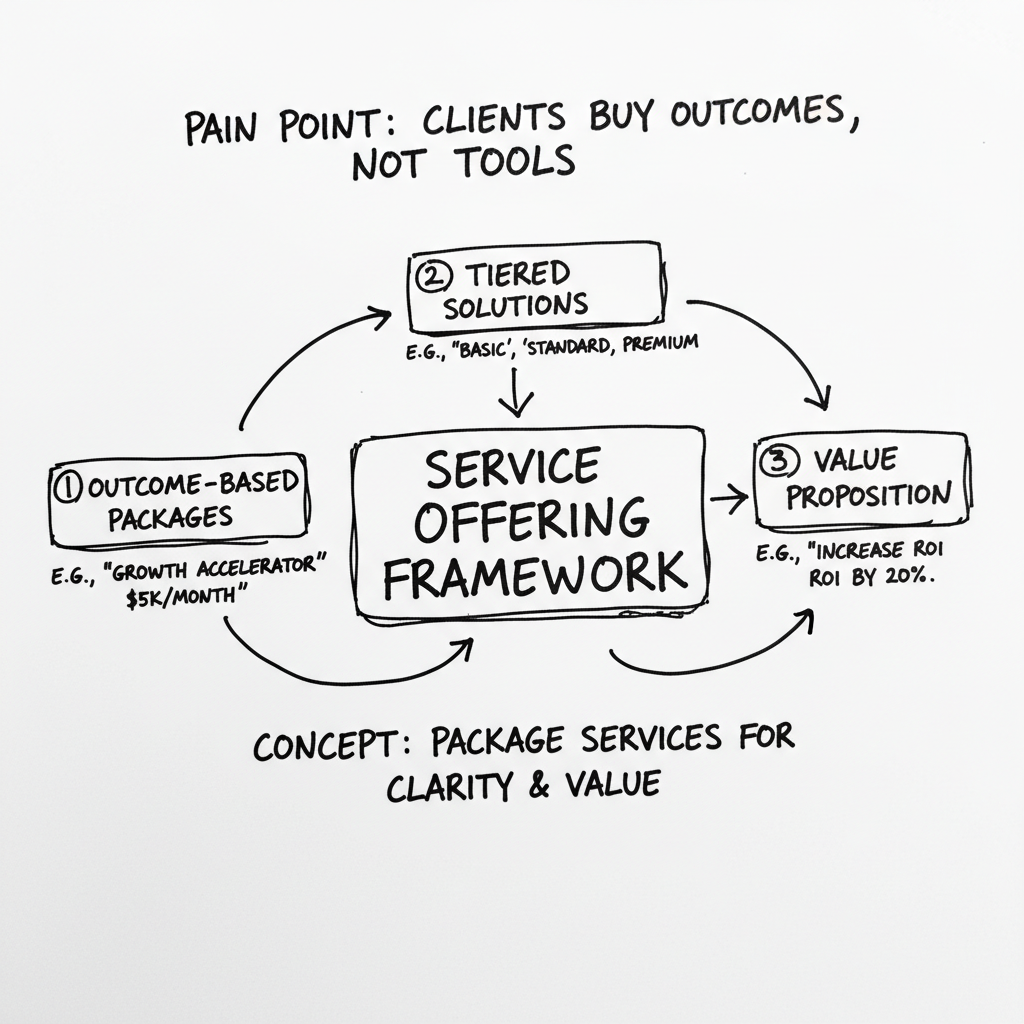
Consulting clients buy outcomes, not tools. Here's how to package your services:
Offering 1: Discovery & Strategy (USD 1,500-3,000)
What you deliver:
- 2-3 stakeholder interviews
- Current workflow analysis
- GPT opportunity identification
- Recommended implementation roadmap
- ROI projection
Why clients buy this: Low commitment way to validate GPT potential before building
Time investment: 8-12 hours
When to sell: To larger orgs (50+ employees) or cautious buyers
Offering 2: Single GPT Development (USD 2,000-5,000)
What you deliver:
- Custom GPT built to spec
- Knowledge files prepared and uploaded
- Instructions documented and tested
- 2 rounds of revisions included
- 30-day support window
Why clients buy this: Solves specific, high-impact problem immediately
Time investment: 12-20 hours
When to sell: To businesses with clear, defined use case
Offering 3: GPT Suite Implementation (USD 8,000-15,000)
What you deliver:
- 3-5 interconnected GPTs
- Unified knowledge base
- Team training documentation
- Integration with existing tools
- 90-day support and optimization
Why clients buy this: Transforms entire workflows, not just one task
Time investment: 40-60 hours
When to sell: To departments or companies ready to systematize with AI
Offering 4: Ongoing Retainer (USD 2,000-5,000/month)
What you deliver:
- Monthly GPT optimizations
- New GPT development as needed
- Priority support
- Quarterly strategy reviews
- Continuous improvement
Why clients buy this: Ensures GPTs stay effective as business evolves
Time investment: 10-15 hours/month
When to sell: After successful project delivery, to maintain relationship
Positioning and Specialization

Generalist consultants compete on price. Specialists charge premiums.
Poor positioning (competitive, low-margin): "I build Custom GPTs for businesses"
Strong positioning (defensible, high-margin): "I help law firms automate client intake using Custom GPTs that understand legal terminology and compliance requirements"
Specialization Options
Choose industry OR function:
Industry specialization:
- Healthcare (HIPAA-compliant GPTs)
- Legal (case research, document review)
- Real estate (property analysis, client screening)
- Finance (risk assessment, portfolio analysis)
- Manufacturing (quality control, supply chain)
Functional specialization:
- Customer support automation
- Sales enablement (proposals, outreach)
- HR and recruiting (screening, onboarding)
- Marketing (content generation, ad copy)
- Operations (process documentation, SOPs)
Why specialization increases prices:
- You understand industry-specific problems
- You build relevant knowledge bases faster
- You can show industry-specific case studies
- Clients trust specialists more than generalists
To Building Custom GPTs: The Complete Technical Guide, see our Building Custom GPTs: The Complete Technical Guide.
Finding Your First 5 Clients
Cold outreach works better for consulting than it does for selling products.
Channel 1: Warm Network
Who to contact:
- Former colleagues
- Professional contacts on LinkedIn
- Industry Slack/Discord communities
- Alumni networks
The approach:
Subject: Quick AI automation question

Hi [Name],

I'm helping [industry] companies automate [specific task] using Custom GPTs.
Noticed [their company] likely deals with [specific problem].

Would you be open to a 15-min call to explore if this could work for you?
Not a sales pitch - genuinely want to understand your workflow first.

Best,
[Your name]
Why this works: No pressure, focused on understanding, warm relationship
Channel 2: LinkedIn Outreach
Who to contact:
- Decision makers in your target industry
- People posting about automation challenges
- Companies announcing growth (hiring = process scaling needs)
The approach:
- Comment thoughtfully on their posts (build familiarity)
- Connect without pitch
- After acceptance, share relevant case study
- Offer specific value (free audit, insights)
- Book discovery call
Target: 20 outreaches → 5 responses → 2 calls → 1 project
Channel 3: Content Marketing
What to create:
- LinkedIn posts showing before/after GPT implementations
- Industry-specific GPT use case breakdowns
- Video walkthroughs of GPT solutions
- Case studies with real client results
Distribution:
- LinkedIn (3-5 posts/week)
- Twitter/X (daily)
- Industry-specific newsletters
- Reddit communities (provide value, don't spam)
Timeline: 30-60 days before inbound inquiries start
Channel 4: Partnership Referrals
Who to partner with:
- Business consultants in your target industry
- Software implementation specialists
- Marketing agencies
- Web developers and design studios
The offer: "I pay 20% referral fees for Custom GPT projects. If you have clients who could benefit, I'll deliver exceptional work and we both earn."
Why this works: Partners have trust and client relationships already
Pricing Your Services
Consulting prices should reflect value delivered, not hours worked.
Value-Based Pricing Framework
Step 1: Quantify the client's current cost
Example:
- Customer support team: 3 people × USD 40k salary = USD 120k/year
- Time spent on repetitive questions: 30%
- Current cost of the problem: USD 36k/year
Step 2: Calculate potential savings
GPT reduces repetitive question time by 70%:
- Annual savings: USD 36k × 70% = USD 25,200
- 3-year savings: USD 75,600
Step 3: Price at 10-20% of first-year value
Your price: USD 2,500-5,000 (10-20% of USD 25,200)
Client's ROI: 5-10x in first year alone
Price Ranges by Project Type
| Project Type | Low End | Mid Range | High End |
|---|---|---|---|
| Single GPT | USD 2,000 | USD 3,500 | USD 5,000 |
| GPT Suite (3-5 GPTs) | USD 8,000 | USD 12,000 | USD 15,000 |
| Enterprise Implementation | USD 15,000 | USD 30,000 | USD 50,000+ |
| Monthly Retainer | USD 2,000 | USD 3,500 | USD 5,000 |
Factors that increase prices:
- Larger companies (bigger budgets)
- Regulated industries (compliance requirements)
- Mission-critical systems (higher stakes)
- Ongoing support included
- Tight deadlines
Delivery Process (What Actually Happens)
A repeatable delivery process ensures quality and reduces your time per project:
Phase 1: Discovery (Week 1)
Activities:
- Stakeholder interviews (1-2 hours each)
- Workflow observation
- Current solution analysis
- Success criteria definition
Deliverables:
- Discovery document (10-15 pages)
- Recommended GPT architecture
- Timeline and milestones
- Revised price quote (if scope changed)
Phase 2: Development (Weeks 2-3)
Activities:
- GPT instruction drafting
- Knowledge file preparation
- Action configuration (if needed)
- Internal testing
Deliverables:
- Functional GPT in development environment
- Draft instructions document
- Knowledge file inventory
Client touchpoint: Mid-development review (30 min)
Phase 3: Testing & Refinement (Week 4)
Activities:
- Client testing with 5-10 representative scenarios
- Feedback collection
- Edge case handling
- Performance optimization
Deliverables:
- Revised GPT based on feedback
- Test results documentation
- Updated instructions
Client touchpoint: Final review session (1 hour)
Phase 4: Deployment & Training (Week 5)
Activities:
- GPT deployment to production
- Team training session
- Documentation delivery
- Handoff and knowledge transfer
Deliverables:
- Live, production GPT
- User guide (5-10 pages)
- Admin documentation
- Training recording
Client touchpoint: Training session (1-2 hours)
Phase 5: Support (Weeks 6-9)
Activities:
- Monitor usage and performance
- Address issues or questions
- Minor optimizations
- Collect feedback for case study
Deliverables:
- Performance report
- Optimization recommendations
- Case study draft (with client approval)
Client touchpoint: Weekly check-ins (15-30 min)
Scaling Your Consulting Practice
Once you've delivered 3-5 projects successfully, scale through:
Strategy 1: Productized Services
What this means: Package consulting into standardized offerings
Example productized service: "Customer Support GPT - Standard Package"
- Price: USD 4,500 (fixed)
- Delivery: 3 weeks (fixed)
- Scope: 1 GPT, 2 revisions, 30-day support
- No discovery phase, no customization beyond defined scope
Why this works: Faster sales, predictable delivery, scalable
Strategy 2: Team Expansion
When to hire:
- After delivering 10+ projects
- When you have more leads than capacity
- When projects are consistently profitable
Who to hire first:
- Junior GPT developer (execute your process)
- Project manager (handle client communication)
- Sales/BD person (book more calls)
Margin math:
- You charge clients: USD 5,000/project
- You pay junior dev: USD 2,000/project
- You keep: USD 3,000 margin
- You scale: 10 projects/month = USD 30,000 margin
Strategy 3: Platform Partnerships
Partner types:
- Software vendors (add GPT development to their services)
- System integrators (offer GPTs with enterprise software)
- Agencies (white-label your services)
Revenue share:
- Partner finds client and manages relationship
- You deliver technical work
- Split revenue 50/50 or 60/40
Why this works: Partners have distribution, you have expertise
Frequently Asked Questions
How technical do I need to be?
You need to understand GPT instructions, knowledge files, and Actions (API configuration). You don't need coding for most projects. For complex integrations, partner with a developer.
What if a client's use case is beyond my skills?
Be honest, offer to collaborate with technical partners, or refer to specialists and take a referral fee. Never fake capabilities.
How do I handle scope creep?
Clear SOW (statement of work), change request process, and firm boundaries. Additional requests = change orders with new pricing.
Should I offer free pilots or audits?
Small free audits (30-60 min) help close deals. Free pilots (full builds) rarely convert and waste time. Charge for pilots if you include them.
What if the GPT doesn't deliver promised results?
Set realistic expectations upfront, include revision rounds, and have a "success criteria" section in your contract. Most failures come from misaligned expectations, not technical issues.
How do I get testimonials and case studies?
Build this into your process. At project completion, request:
- Quantified results (time saved, accuracy improved)
- Written testimonial (provide template)
- Permission to create case study
- Intro to 2-3 similar companies
Start Your GPT Consulting Practice
GPT consulting turns expertise into immediate revenue. No audience, no distribution delay, no product development risk. Just value delivery.
Your next steps:
- This week: Choose your specialization and package 2-3 service offerings
- This month: Close your first paid project (target: USD 2,500+)
- Next 90 days: Deliver 3-5 projects and build case studies
For GPTs requiring access control, TheGPTShop provides secure access codes starting at USD 5 - perfect for client deliverables.
To learn more about custom gpt monetization, see our Custom GPT Monetization: 6 Revenue Models That Actually Work.
Related Articles
- Custom GPT Monetization: 6 Revenue Models That Actually Work
- Building Custom GPTs: The Complete Technical Guide
- How to Price Your Custom GPT Access
- Do Custom GPT Creators Get Paid?
Sources & Citations:
- Freelance and consulting pricing benchmarks (2024-2026)
- Service business scaling frameworks
- Custom GPT development best practices


